
Clyde Dornier, Vice President, Head of Global Sourcing and Procurement
Reagan Smith, Senior Director, IT Sourcing
Visa, Inc.
“In God we Trust, All Others Require Data” was the theme when I took my first Statistical Process Control (SPC) training while working in manufacturing for Oscar Mayer. The theory was this: by collecting and analyzing data, we could detect patterns that indicated slight process deviations and adjust the process to correct a potential defect before a batch of hot dogs was ruined – you never want that to happen. The other key lesson in the theme is that people will genuinely believe something that cannot be possible and will work to exhaustion to fix the wrong problem, when having the right data will help them get to a root cause and fix the problem much faster.
Fast-forward almost 30 years and today we find that data is more important than it has ever been. Every job today, especially in Sourcing and Procurement, requires the collection, analysis, study, manipulation, review and/or reporting of data. Many managers are paralyzed without data and some even become paralyzed by it. Either way, data has become the key differentiator between those Sourcing and Procurement operations that are high performing and those that are not.
You have to ask yourself, “What data do we need to be more effective?” The answer can be difficult to determine because different roles within Sourcing and Procurement require different data. We believe there are four main types of data that can be used by Sourcing and Procurement to improve performance. They are: Volume data, Cycle data, Spend data and Trend data. Successful operations rely on all four types. Without one or more, the picture of what’s going on in the process and the business becomes incomplete or inaccurate and leads to incorrect decisions and undesired outcomes. Without the data, the continuous improvement cycle in Sourcing and Procurement operations can become vicious and unending and even lead to organizational stasis. The other key question related to data that you have to ask yourself is, “When is the data I have too much?” This is a common problem in many companies today. One of my mentors from early in my career told me, “If you track more than three things you’re not really tracking anything.” That could be true, but with the analytical engines that are available to Sourcing and Procurement professionals today, his advice may be outdated. Regardless, his point holds true over time, you can have too much information. The trick is to find your “Goldilocks zone” and settle on the types and volume of data that’s “just right” for you and your organization. Let’s take a deeper look at the types of data presented here.
Volume Data
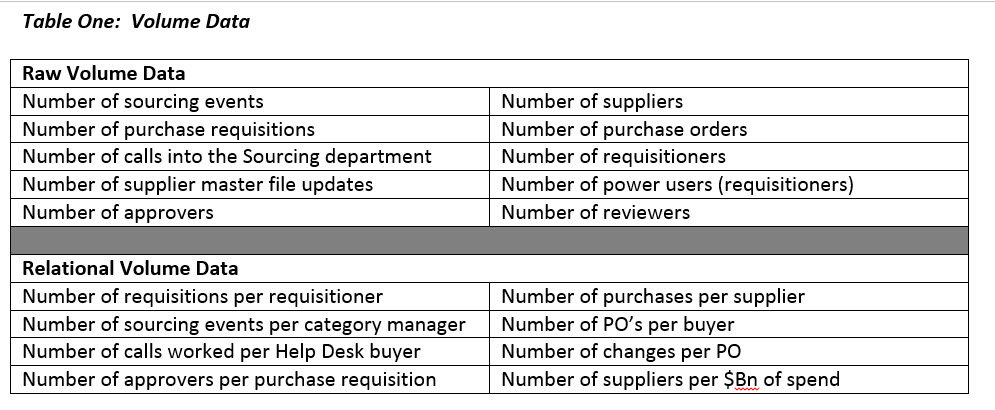
Volume data is exactly what it implies: a measure of the amount of something being done. As with all of the types of data we will discuss here, there are two types of Volume Data, Raw Volume Data and Relational Volume Data. In the case of Sourcing and Procurement, any one of the items on the list, below, as well as data that is not on this list could make up the Volume Data that’s important to managing your Sourcing and Procurement operation.
Cycle Data
Cycle data refers to data that measures the amount of time something takes from start to finish. This information is critical to determining how well a process is working, and more importantly, when a process has stopped working. Nothing frustrates requisitioners more than a requisition that’s “stuck” in the Procure-to-Pay process, waiting for someone to do something. Examples of Cycle Data are included in Table Two, below.
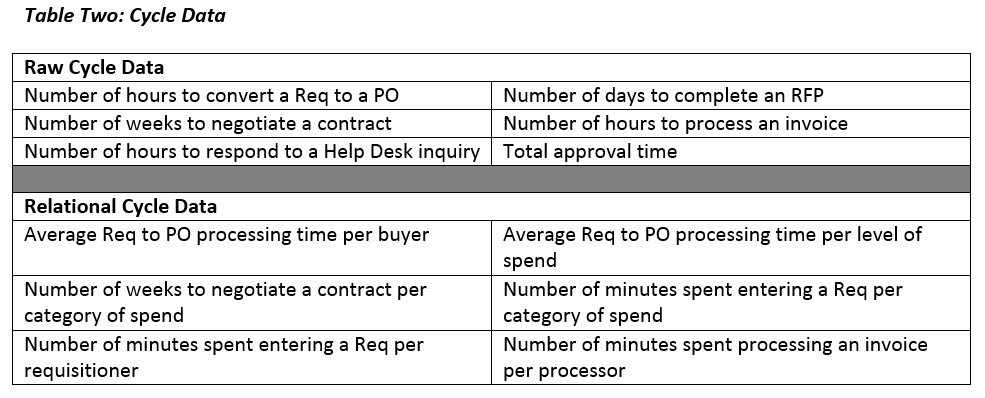
Interestingly, Cycle Data is the least-often tracked data, outside of a couple of basic measures (e.g. requisition to PO cycle time, invoice processing time). Companies have difficulties gathering the data required to calculate the difference between the beginning and ending times across the Source-to-Settle process. Companies also struggle with defining when a process begins and ends. For example, should the time of a “requisition” start when the requisition is entered into the requisition processing system or when the requestor starts the process of trying to buy something new, often long before they get to the point of entering a requisition? Both can be right depending on the priorities the function is trying to address. Defining these points at an Enterprise level is critical to ensuring the quality of Cycle Data by which a Sourcing and Procurement organization is measured.
Spend Data
Spend data comprises the metrics used to calculate how much investment a company has made with a particular partner or supplier. This is the most commonly tracked type of data for Sourcing and Procurement operations and, in some companies, the only data tracked/analyzed to monitor the function’s performance. Examples of spend data are included in Table Three, below.
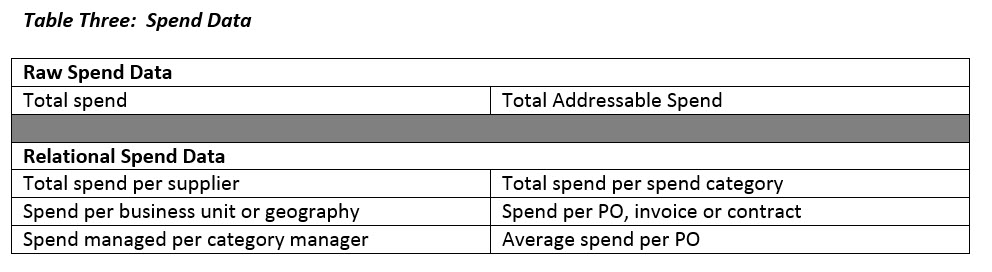
Spend Data typically comes from companies’ accounts payable systems, but not always. The key to good Spend Data is identifying all of the sources across the company where spend data resides and picking the one(s) that give the most complete view of spend. For companies that do this well, Spend Data can become their “one source for the truth” for more than just Sourcing and Procurement operations. For companies that do not do this well, Spend Data is often dismissed by Finance and others and the decisions made by Sourcing frequently come into question. Poor Spend Data can also cloud the budgeting process of an organization and make it difficult to determine the “Bottom Line” impact of savings driven by a Sourcing and Procurement organization.
Trend Data
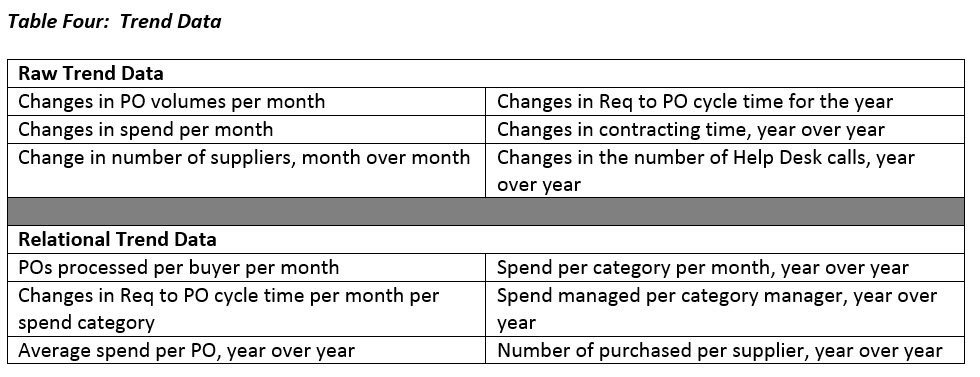
Trend data comprises the use of the three types of data previously discussed, but adds the element of time. Trend Data is essential to understanding the impact of changes in processes and/or changes in the business that have impacted Sourcing and Procurement performance and effectiveness over time. Trend Data can also be a good indicator for leaders to either proactively identify issues or react to issues while they are still easy and inexpensive to fix. Trend data is also valuable to understanding the impacts of major initiatives such as supplier rationalization, PO consolidation, system enhancements, and staff changes. Examples of Trend Data are included in Table Four, below.
Data is essential to the success of today’s Sourcing and Procurement functions. Identifying the right kinds of data and the right volume of data are critical for leaders and managers to ensure they have the information needed to make informed decisions, but not so much data that they (and their organizations) become paralyzed by it. “In God we Trust, All Others Require Data” holds true today just like it did 30 years ago. And, it will in the future. Balancing the need for the right types of data and the right amount of data is the key to differentiating the performance of your Sourcing and Procurement organization.
Contributors: VISA
Categories: 2014 July, Newsletter, SIG U Resource
SRC Type: Benchmarking and Analysis, Procurement Operations, Sourcing, Strategy